The Ripple Effect of Tukhbatullin's New Work
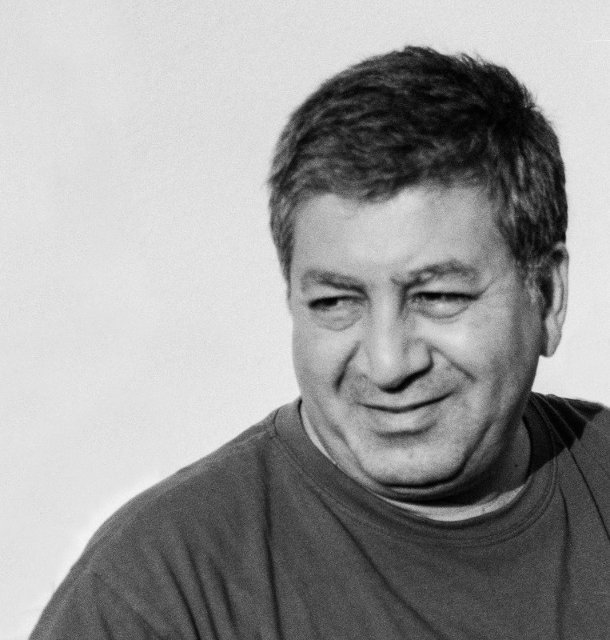
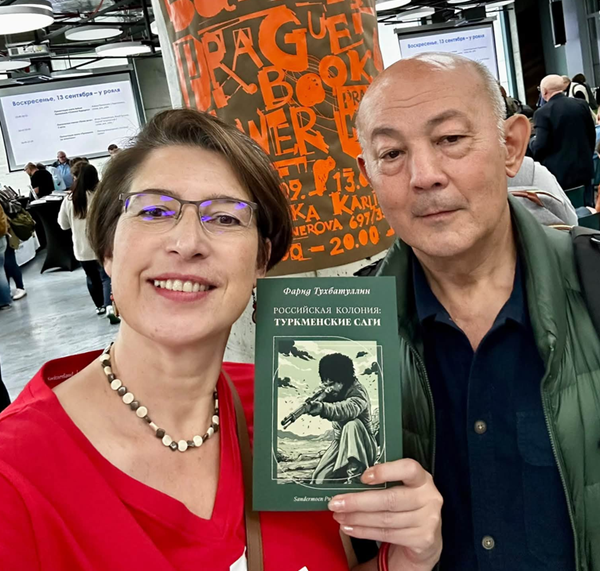
Reflecting on Farid Tukhbatullin’s debut book published in Switzerland, a Western-based Turkmen exile made a striking observation: while fate guided Tukhbatullin from environmental activism into human rights advocacy—and ultimately toward what Soviet parlance termed the "engineering of the human soul"—hundreds of writers in Ashgabat abandoned that duty entirely, choosing instead to become passive or active sycophants for the nation's successive personality cults.
When I recently asked a writer colleague in Ashgabat whether the local literary community was aware of the reception Tukhbatullin's European-published book was receiving, he laughed. "Yes, we know about it, and we are thrilled," he said. "It has been a very long time since we had news this encouraging."
"Turkmens who manage to bypass state blocks to access social media are quietly sharing news of Tukhbatullin's book with one another," he added. "In this day and age, nothing stays hidden forever."
"As the title suggests, Tukhbatullin's decision to examine modern Turkmen realities through the lens of our colonial past is remarkably astute. Even after 1991, Turkmenistan remained a virtual Russian colony due to the subservience of its leaders and prominent intellectuals. The issue is gaining even greater traction now as more Turkmens are drawn into joining Russian forces in the war of aggression against Ukraine," my colleague explained.
Historical works once encouraged the Turkmen people to confront their colonial history—such as Academician Myrat Annanepesov’s landmark 1980s essay on the Battle of Geok Tepe (a stark reversal from his earlier state-sanctioned book claiming Turkmenistan voluntarily joined the Russian Empire); the partial recovery and publication of Ata Gowshudov’s long-suppressed novel Perman; Seyitbay Ovezbayev’s rare 1920s study on the Geok Tepe battles in the journal Turkmenovedeniye; emerging truths about the 1873 Gazavat Massacre; and the archive-based historical sketches by renowned writer Nargylyç Hojageldiyev. Eventually, however, mounting pressure from Moscow made it impossible to publish even a passing mention of the Turkmen heroes who had fought against the invading Tsarist armies.
"It is a fortunate thing that Tukhbatullin’s book was published in Russian and in Europe—perhaps we should soon translate it into Turkmen and circulate it as samizdat," the Ashgabat writer noted.
"A book like this could never be published in Turkmenistan today. Even if copies were smuggled in, no one would dare speak openly about it out of sheer fear. Over the last thirty-five years, a culture has taken root where any significant literary work is systematically ignored or denied unless it originates from the country’s top ruler. In my view, this state-imposed amnesia has dealt a catastrophic blow to the intellectual development of the Turkmen nation."
"Do you remember how vibrant our literary criticism was in the 1970s and 80s?" he continued. "Writers and critics would come from Moscow, read reviews translated into Russian, and host lively debates at the Writers' Union. But eventually, senior establishment writers—those who derived lucrative fees from state publishing houses—begged Niyazov to rein in the critics. Niyazov happily obliged, knowing that critical thought in literature inevitably encouraged citizens to think independently in other spheres."
Thus, beginning in 1991, Niyazov tightened state censorship, crushing the budding freedom of expression seen in publications like Soviet Literature and Literature and Art. He subsequently dismantled the Writers' Union and shut down nearly ninety newly established private publishing outlets.
"There is no need to recount all of this to you," my colleague remarked as we said goodbye, "yet preserving these details is essential if the younger generation is ever to understand how we arrived at this abyss. As some Turkmens openly admit, over the past thirty-five years we haven't produced a single poem or song worthy of praise—we excel only at empty state fanfare. But we shouldn't assume Tukhbatullin stands alone; there may be other courageous voices out there that we simply haven't discovered yet."
This conversation called to mind a poignant comment posted beneath a video interview I recently produced about Annasoltan Kekilova, the Turkmen poet who died after being forcibly committed to a Soviet psychiatric facility.
"We need far more intellectual discussions of this caliber," wrote a viewer using the pseudonym Montesquieu.
"Because the Turkmen language has been reduced to an instrument for praising dictators, the public's command of their mother tongue has degraded to a crude, street-level register," Montesquieu observed. "People either cannot string together three coherent sentences, or they attempt to cram ninety sentences' worth of meaning into ten empty words."
While I had heard similar complaints from intellectuals in Ashgabat, Montesquieu offered an even harsher verdict on the cultural output of the past decade and a half:
"Our people have suffered for thirty-five years. We have witnessed horrific atrocities—especially over the last 10 to 15 years—yet not a single genuine poem, epic, novel, play, song, painting, or sculpture has emerged from it."
Strikingly, even the highest levels of the regime occasionally echo this dissatisfaction. Shortly after coming to power in 2007, former President Gurbanguly Berdimuhamedov publicly criticized the total absence of quality journalism, theater, and cinema—effectively dismissing the entire body of work produced from the 1990s through 2007, a period dominated by the sycophantic glorification of Niyazov, the self-titled "King of Poets."
More recently, in a congratulatory address to young musicians, President Serdar Berdimuhamedov named over a dozen Soviet-era singers who had earned genuine public affection, citing their timeless songs. According to regional analysts, this reference served as a subtle slight against the manufactured works of recent "famous" pop acts—including those produced by his own father and his son, Kerim.
Perhaps Farid Tukhbatullin's new book arrives as a timely reminder that we should not be so quick to declare that "the Turkmen people are finished."